Showing posts with label Book Reviews. Show all posts

Thursday, June 8, 2017

Mr. Penumbra's 24-Hour Bookstore by Robin Sloan

Clay Jannon, unemployed graphic designer, wanders down a suspicious-looking street and finds the interestingly-named Mr. Penumbra’s 24-hour bookstore, where he is hired as the night clerk. Over time, he discovers the bookstore: a small and quirkily selected independent section remains up front, but beyond that lies what he calls the “Waybacklist” shelves: three stories tall, reachable only by a ladder, and known only to the database that lies on an ancient Mac at the front desk. He meets the patrons of the bookstore: the occasional person who works at the nightclub next door, elderly visitors with mysterious encrypted membership cards who borrow and return books from the Waybacklist, and one very special Googler who admires his graphic design and coding skills. Eventually, he finds himself drawn into a mystery including his employer Mr. Penumbra, Google, the Waybacklist, and the very origins of books themselves.

 This is one of my favorite books. While it takes place in San Francisco, New York, Nevada, and even the Google campus, the worldbuilding of the bookstore and Google and even Clay’s apartment is stunning. It might be literary fiction, but it evolkes all the wonder of, say, YA fantasy. It’s a quirky story in everything from the plot to the dialogue to the settings. Honestly, who wouldn't want to work at a 24-hour bookstore? A cryptic one that's one big puzzle? Who wouldn't want a cast of characters in your life that includes a quirky yarn museum curator, a animatronic-building artist, and a peculiar bookseller mentor? 

If you’re a fan of character-driven stories, however, this is not necessarily for you. Some tropes and some flat characters make unimportant appearances, and the plot is propelled less by any one character’s genius than by some seemingly out-of-the-blue eureka moments.
 The cover is cheery yellow and minimalist, and the text is whimsical—it made me want to pick the book up after it had been recommended to me. 

 5/5 stars

P.S. This book contains one of the more accurate representations of Silicon Valley in popular fiction.

Happy reading,
~Citali

Friday, December 30, 2016

Six of Crows by Leigh Bardugo: Book Review

Happy 2017! I figured to start the new year with a massive current fave.

Want a terrifying fact? It's been more than a year since my (our) last book review post, which was for Dorothy Must Die back in October 2015. Now to fix that!

Six of Crows and its partner in crime (the second half of its duology), Crooked Kingdom, are masterpieces. To break it down to whatever might make you pick up a book: the plot, the worldbuilding (*swoon*), the quotability, the characters (*double swoon*), and the amazing fandom, all of them are amazing and cinammon roll-y.

The plot: A thrumming heist story full of twist after twist, reveal after reveal, triumph over triumph. It's almost impossible to put down; it starts with a bang and ends heart-wrenchingly but hopefully.

The worldbuilding: Taking place in a gritty low fantasy city resembling Amsterdam in the nineteenth century. Realism, well-built infrastructure both in and out of the narrative, and the intriguing system of the Grisha Small Science (what others might think of as magic).

The quotability: Here are just a few favorite bits:
  • “It's not natural for women to fight."
    "It's not natural for someone to be as stupid as he is tall, and yet there you stand.” 
  • Kaz leaned back. "What's the easiest way to steal a man's wallet?"
    "Knife to the throat?" asked Inej.
    "Gun to the back?" said Jesper.
    "Poison in his cup?" suggested Nina.
    "You're all horrible," said Matthias.
  • "Why does it matter?”
    “I don’t know!” Jesper said angrily. “Maybe I liked your stupid face."
There's just so much quality banter and everyone loves/hates each other and they're just all amazing.

The characters: Personally, they're my favorite part. I present the following:
  • A former acrobat, stolen as a slave, sold as an "indentured servant," now the best spy in the city and ready to fight for her life and her friends
  • A young man who's immensely secretive about his past, who's risen to his title of "Dirtyhands" among the grittiest gangs of Ketterdam by ruthless crime and grudging respect
  • A girl who can turn people's bodies against them, a trained soldier in Ravka's army, far from her home
  • A still-loyal soldier of Fjerda, Ravkans' enemy, imprisoned miles from his nation and battling allegiances
  • A sharpshooter with a gambling problem and a longing for trust
  • An innocent demolitions expert who is ACTUALLY A CINNAMON ROLL (Calm down, Citali)
The fandom: As fandoms go, the SoC/CK fandom is still pretty small and amazing. Also we have... like... amazing fanartists? Like the actual angel who drew this Inej and Wylan sketch:


The genre: It seems to bridge genres: young adult fantasy, with a tinge of LGBT+ fiction, as well as a heist narrative, combined with an action plot full of twist after twist. Each of the main character simultaneously makes the reader adore them and hate them. Each plot twist elevates the plot and keeps the reader completely engaged--the book is virtually “unputdownable.” It’s also followed by an, if possible, even better sequel (Crooked Kingdom) and preceded by a trilogy, letting readers who are hooked dive even further into the author’s worldbuilding.

This series is just So! Good! Agh!

Happy reading!
~Citali


Saturday, September 3, 2016

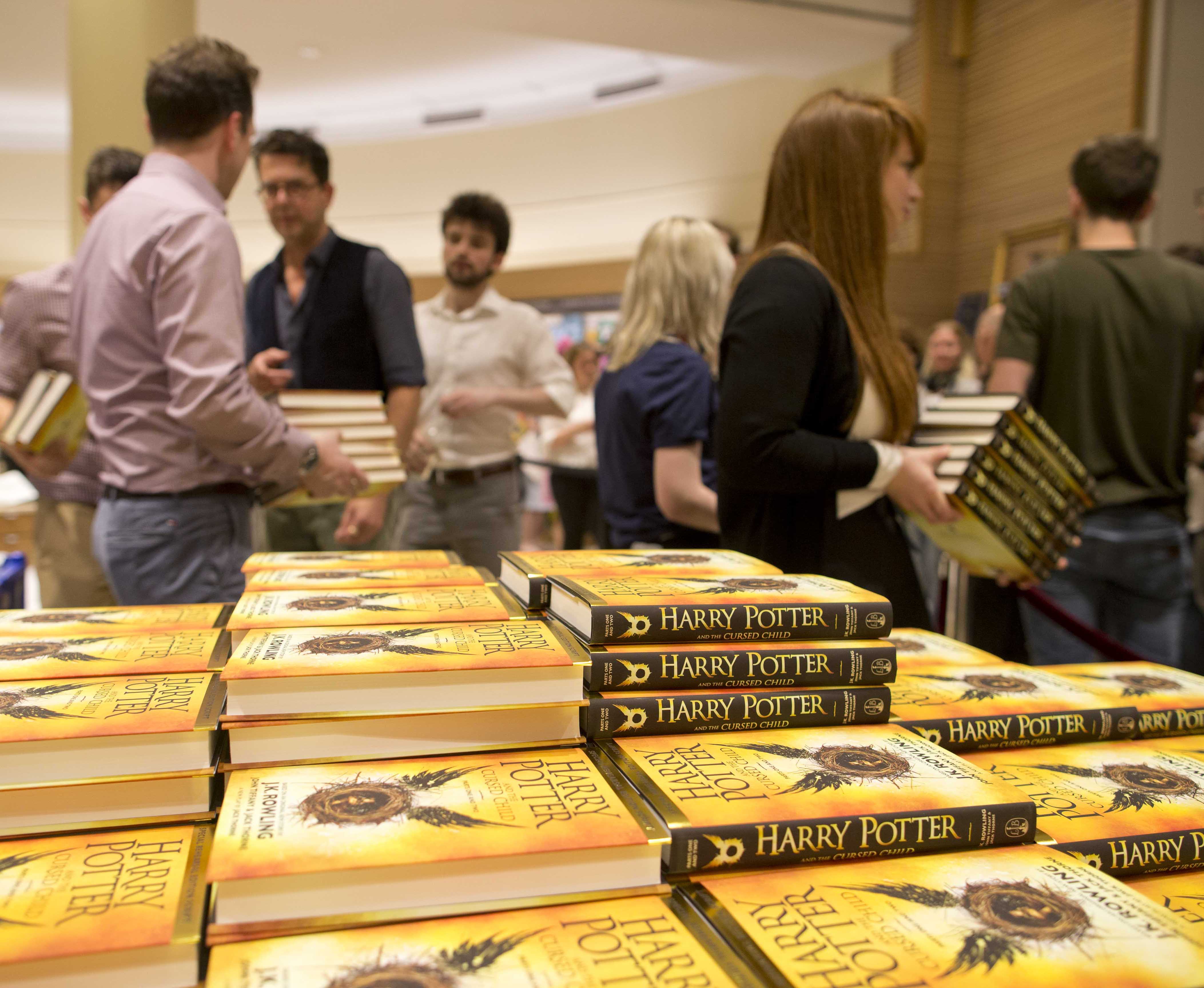
A Long-Winded Love Letter to Harry Potter and the Cursed Child

So.

I read it.

The "it" I'm referring to is, of course, Harry Potter and the Cursed Child, the script of a recent play in London. It's Rowling-approved and officially canon, and ever since it came out it's been a source of extreme controversy within the fandom.

I, myself, quite liked it.

This is actually the second post on this blog about The Cursed Child. Citali wrote one already (go read it! It's far more eloquent than I could ever be), but I actually disagree with her opinions somewhat, so here I am. This post's probably going to be less coherent and more rambly, so you've been warned.

The book's in script format, so it's like (as quoted from one of my friends) reading Harry Potter on fast-forward. That, and the fact that the plot wasn't quite as stellar as we've come to expect from Rowling, explain why it's gotten less-than-great reviews from those who've read it.

However.

The Cursed Child is so, so important in that it acknowledges the characters' flaws and traumas. Lily and James and Rose are exactly what their parents wanted, perfect friendly happy Gryffindor children, not a care in the world, their parents' perfect legacy, but Albus? Oh, Albus. Albus Severus Potter: Slytherin, friendless, tormented, lonely. Albus, who so desperately wants to be more than just Harry Potter's loser son, Albus whose only friend is the son of Draco Malfoy, Albus who doesn't understand his father, whose father doesn't understand him, who isn't sure what to do about it and--

this is important, here. Not everyone is Harry Potter, who came to school and built a Golden Trio. Not everyone is Harry Potter, who stepped into the Wizarding World and became the youngest Seeker in a hundred years. Not everyone is Harry Potter, the golden child, the hero, the star, the Boy Who Lived.

This book, I think, focuses so much on stepping out of legacies and shadows. It takes Albus and Scorpius (and even Rose, to some extent) and says, firmly, "No. We are not our parents." Who would've thought, nine years ago, that there would be a tolerant Malfoy and a prejudiced Weasley?

I like this book because it forces you to confront the fact that its characters are imperfect, are scarred. That Harry Potter (the Chosen One, the one who killed the Dark Lord) is afraid of the dark. That Dumbledore made a hideous mistake in choosing to keep Harry with an abusive family (and wasn't reading that incredibly cathartic?). That Amos Diggory, all these years later, is still aching because his son was written off as merely "the spare." Rose Granger-Weasley, daughter of a Mudblood and a blood traitor, turns her nose up at Albus because he's friends with a Malfoy.

(I'm not saying The Cursed Child is perfect. It isn't, especially plotwise. I'm just saying that it's worth reading, because it delves into what Rowling didn't. )

Another thing. As we well know, Harry Potter suffers from a lack of diversity, both racially and otherwise. The Cursed Child (the play, I mean) cast Black actresses to play both Hermione and Rose Granger-Weasley. (!!!!! I know, right? So great.) In addition, although it's been confirmed that the late, the great Albus Dumbledore was in fact gay, he's the only canonically LGBTQ+ character in the Wizarding World thus far. Dare we hope Cursed Child is taking the first steps to change that? Nothing is stated explicitly, but. Reading the book, Scorpius's and Albus's interactions feel very much like the first steps towards romance. I'm gonna be honest with you: I ship it.

(Didn't I tell you it was going to be rambly? Hopefully it made sense.  ¯\_(ツ)_/¯ )

Anyway. If any of you have read it, feel free to tell us what you thought of it!
Happy reading, as always.
~Willow

Monday, August 29, 2016

Harry Potter and the Cursed Child (Or, yes, it's problematic, but the magic goes on)


Let's talk Potter.

Again.


I don't want to say that the HP fandom has been dead since 2007 (when Deathly Hallows came out) or even 2011 (when Deathly Hallows Part 2 came out). Because it hasn't been. There are intriguing fan theories, beautiful fan art, the continuing lives of the actors. There is and was the site pottermore.com, the controversial quasi-canon source of extra-series information.


Willow started reading Potter around 2009. At least, that's when she started talking about it. [correct me if I'm wrong] I started reading Potter in the summer of 2012. It was part accidental, part a long time in the making. My family had owned Sorcerer's Stone for a while. I finally picked it up, and I was hooked. I went through the series in about two weeks, averaging a day for each book: I'd start a new book in the morning, read it during the day during breaks, and finish it usually by the time I slept. Neither of us followed the fandom from the first book release. But now we're both die-hard Potterheads, and I don't think either regrets it. I am a Potterhead.

But The Cursed Child is changing all that.

Primer: Harry Potter and the Cursed Child is a new play. It's Rowling-approved, technically canon. It's a script published on July 31, 2016 (because that's Harry's birthday, and also Rowling's. Though obviously not this year). It's a two-part, four-act play currently being performed in London. And it's a Thestral in the room for the fandom, and the fandom is doing some weird discourse about this.

Here's the problem as I see it, based on the discourse of other people who see it. The magic of the Harry Potter books is based on the fact that these characters do not just exist in paper and ink. They live. And Hogwarts and the Wizarding World live, too.

**Very Mild Spoilers**

Harry Potter is problematic. People can write essays on his flaws and his actions and his choices and his bumping into suits of armor when looking at maps and the significance of this in the revealing of his innermost thoughts. (Has anyone ever read Harry Potter and Philosophy? It's actually a quite fascinating set of essays.) Ron Weasley's friendship can be expanded by people who fill the spaces between the lines and between the scenes and between the chapters with day-to-day life at Hogwarts and the power of friendship and platonic love between two boys--men--who might as well have been born brothers. Hermione Granger's very canonical descriptions can be analyzed to their core by scholars or by fangirls or by the beautiful people who can be both or by the artists who bring their vision of Hermione to their very own lives.

Joanne Rowling took an idea that came to her on a train to Manchester and expanded it to fill seven volumes, thousands of pages of words that built a world hiding just behind a platform barrier from ours. And she set it loose into the world, and people built their own magic upon it. And since 2007, people have been drawn into the world of those books. People have been building worlds inside worlds, the stories of unvindicated characters.

And we were Book Eight. "We Are Book Eight" is a slogan of the Harry Potter Alliance. It's an organization that gathers fans of fantasy to bring them together in acts of real-world activism, fantasy expanding into the real world, love of community and words weaponized. "The Weapon We Have Is Love."

But now Book Eight is a position that's taken, a position usurped by a play that comes in nine years later. A position that was filled before it came. A position filled by the millions of pages of fanfiction and fan art and headcanons and ideas and activism that is Book Eight.

And all that. Gone. Vanished like potion out of Harry's cauldron in Snape's dungeon. Officially noncompliant. Cather Avery's Carry On, Simon after Simon Snow and the Eighth Dance. The feeling of finality of headcanons and fanfictions that all became AUs at the crack of midnight on July 31st.

People have written about the nextgen. Rose Weasley. Teddy Lupin. Albus Severus Potter. Scorpius Malfoy. Poof. Avada Kedavra.

So I'm against Cursed Child, on principle. I wasn't sure whether I wanted to read it or not.

My takeaway: Cursed Child has the same kind of impact as Pottermore.com. It's technically canon. Fanon doesn't agree. And while I was doubtful at first, I agree with fanon.

I want to read canon where Harry is no longer a main character. Where the nextgen is about the nextgen. Where the children of Dumbledore's Army have, like their audience, accepted the problems of the previous generation and moved on to bigger and better things. Where Teddy Lupin unites the Blacks and the Potters and the Weasleys. Where Albus Severus's name is a homage to two problematic headmasters who did wonderful things and terrible things and both for wrong reasons and redemption is in the form of a hero's son's name. Where not all the drama happens around the Quidditch field. Where there can be Slytherin hangings in the Room of Requirement. Where you don't need a time-turner to explore new worlds. The canon that's already been written by fans in the void of online and the caverns of seventeen-cent notebooks and in the King's Cross stations that are imaginations.

But I read The Cursed Child. In an evening.

And, well, objectively, I disliked the first three acts (of four). In hindsight, that might be due to the script medium, a medium I feel maybe didn't capture the magic in its stage directions and cast descriptions that can be built up by a few well-written full sentences or a shot in a movie. It might be due to the time-travel plot that I felt was a little bit cliché. It might be due to the characterization, where every returning character felt like a shadow (Ron, Ginny) or a parody (Hermione, Harry). And all the opportunities that fans have written for Ginny's strength or Ron's imagination or Harry's hope or Teddy Lupin's power to unite families or anyone's opportunity to build interHouse relationships weren't there. It might be due to the worldbuilding and the flashing through different realities that seemed almost without plot. It might be due to the fact that I didn't really like it from the beginning, and I went in with a preconception, something I regret.

But the fourth act got better. And it redeemed, for me, a little bit, the plot. In the fourth act, I was reading to find out what happened next, not to move through pages. This feels hollow and short, but I quite liked the ending. Considering the beginning, I think it was a good ending.

But it's like the How To Train Your Dragon movie adaptation. I don't think they're the same characters. I don't think Cursed Child Ginny is Original Ginny. I don't think Cursed Child Draco is Original Draco. Because Original Ginny would have grown up differently. Original Draco would have been redeemed.

Here's what I'm doing following The Cursed Child.

1. I've read the book. I've acknowledged its existence and its impact. I've noted that objectively I disliked the book at first, but it got better in the end.
2. I will continue to recommend Harry Potter as one of the best things I've ever read. I will recommend Harry Potter as the original seven. I don't think I will recommend The Cursed Child.
3. If I want to write fanfiction in the near or distant future, I will write is as if J. K. Rowling's final words on the subject were on Pottermore.com or in the "All was well" of the epilogue.
4. I will continue to Be Book Eight.

What are you doing?
~Citali

Monday, July 4, 2016

Thriftbooks.com: A Book(store) Review


Maybe you haven't guessed this yet, but I! Love! Libraries! So I'm usually not the one who, when a book gets recommended to me, says, "I'll go buy that!" Instead, I go, "I'll go put that on hold!" The last time I bought a book (before this) was the Iliad from a local bookstore. I had gotten it from the library, but let's be honest, I am definitely not going to finish the Iliad before I have to return it. Plus, it's a good book to own. At said bookstore, the Iliad was pretty expensive (though it pretty much always will be $20+ from any store.) And, well, this was a book I wanted to own. I'm still getting through it, but I think it was worth owning. I'll come back to it, someday, I'm sure. Many times.

While browsing the "wretched hive of scum and villainy" (Thank you, Willow and Obi-Wan Kenobi) of online, though, I came across a reference for the website thriftbooks.com. It does what it sounds like: sells books. Used ones. Cheaply. It's cited a lot as a good place to buy textbooks, which makes a lot of sense. The new books on here are pretty much the bookstore price, that is more than Amazon or other cheap e-retailers. But used books are almost crazily inexpensive.

And the first thing I saw was the Odyssey! Let me emphasize this: for Three. Fifty. Nine. I'm sorry, but that is one-seventh of the price if you bought it new. Almost nowhere, internet or otherwise, will someone let you have a copy of the Odyssey for that amount. Boom. I see why this site has such a good name.


After some browsing and some dithering, I end up with three purchases: The Odyssey, Artemis Fowl, and Fangirl. Which is a lot! More than $25. I'm excited to get these. The Thriftbooks website is, I think, well designed, considering how crazy their inventory must be. They've got a wishlist for saving books they don't have copies of at the time/yet, and their emailing is impeccable, with coupon codes and notifications. I have summer reading this summer, and I need to annotate my books, so I might be returning here again. While their blog is a teense threadbare, there is an extremely interesting video about their process.

Beyond the crazily inexpensive books, they do have lots of deals going on. There's a "Thrift Deal" for certain (a lot of different) books in acceptable condition, with 3 for $10. If you buy $10 worth of books, you get free 4-14 day shipping. And there are emailed coupon codes.

~~~~~~~~~~~~~~~~~~~~~~~~~~~~~~~~~~~~~~~~~~~~~~~~~~~~~~~~~~~~~~~~~~~~~~~~~~~~~~~~~~~~~~~~~~


My books were coming from three different places yet arrived all in a span of three days. The shipping estimate is 4-14 days; these books came in 9-10, so the estimate was correct.


The first arrivals were a new copy of Fangirl and the Acceptable-rated copy of the Odyssey. Thriftbooks reps their recycled packaging a lot: this is what it looks like. New books come in cardboard  boxes; used books come in branded pouches. They shipped well and I can't say too much went wrong. However, just remember that when buying used books to check ratings!

The acceptable Odyssey looks like this: highlighting, penciled annotations. That fits the Thriftbooks quality rating, so it's my fault for not checking up with that. It's readable, of course, just definitely different from a new book. I might buy a new copy later if erasing the annotations doesn't work, just because this is a classic I very well may reread and not an airplane novel paperback. 
No substantive comments on the Fangirl copy, mostly because a new book is a new book. No defects, I suppose. Thriftbooks new books don't come from the same warehouses, but from a different supplier. 


The next day arrived the Very Good-rated copy of Artemis Fowl. A Very Good book looks pretty much new inside. The spine is a little battered, but since I'm a reader who cracks new books intentionally before reading, this meant this copy was as good as new to me. Someone pickier might be bothered, but not me.


Verdict? I'll be shopping here for textbooks/English books in the future: books that will have a price advantage between new (Amazon, Barnes & Noble) and used. I like the quality of the Very Good rated books, so I'll shop for those specifically. Shipping's free for media mail, so to take advantage of that I'd be not ordering anything too urgent. Rating? 4.5/5.

Happy reading!
~Citali

Wednesday, October 28, 2015

Dorothy Must Die by Danielle Paige: Villains Week

Dorothy Must Die is an amazing book by Danielle Paige and is my first post for Villains Week!

This book is one of the weirder classics remixes that I've read: the concept is that Dorothy, instead of going happily home to Kansas, returned to Oz, hungry for power. Becoming princess, she's changed Oz for the worse... the Good are now wicked, and the Wicked are good. Or are they?

Amy Gumm is the Other Girl from Kansas, arriving in Oz also via tornado. As she moves towards the Emerald City, she learns terrifying things about Dorothy's new regime and is recruited by the Revolutionary Order of the Wicked on a mission: kill Dorothy. But who's really Good? Who's really Wicked? Where should Amy stand?

Definitely a teen book with some unpleasantly graphic descriptions of the violence, magical and otherwise, of the evils of Dorothy and her sidekicks, plus some unnecessarily inappropriate references.

However, I do kind of like the plot twists and worldbuilding here. I've read The Wonderful Wizard of Oz and while I can't say I think L. Frank Baum would agree with this book, he might chuckle at it or at least be interested. With the total reversal of Good and Wicked, you never know who the villains are. The characters, too, are interesting, definitely dynamic. Indigo with her tattoos, Jellia, Maude and Ollie, and the Revolutionary Order of the Wicked too, they all are people I want to know better, to find out what happens to them.

I'd say three stars for the excellence with characters and plot, although the theme is definitely not my style. It's certainly memorable in that I will never see Dorothy or Oz the same way again!

Three stars

Happy reading!
~Citali

Wednesday, October 21, 2015

Paper Towns by John Green

Paper Towns book atop a map
A book I'm sure you've heard of: Paper Towns by John Green. As I'm a proud nerdfighter (Vlogbrothers forever!), this review will be unabashedly mixed with references. As a nerd and a reader and an enthusiast for knowledge, nerdiness, weird references, and decreasing worldsuck, I strongly recommend this Youtube channel. Just saying.

Note: I am aware there is a movie. In fact, I am aware there is a movie because I watch John's Youtube channel. I also read this book, An Abundance of Katharines, and The Fault in Our Stars because of the Youtube channel. However, I have seen none of these movies.

Okay! On to the actual review!

Q (Quentin) has always half-had-a-crush-on, half loved Margo Roth Spiegelman, his neighbor and childhood friend/family friend/acquaintance. At school, where both of them are seniors, Margo is the queen and Q is a lowly peasant: they haven't talked in a long time, ever since they found a dead body together (long story). One night, though, Margo opens his window and drafts him as her getaway driver in a prank-filled, heartbeat-increasing-to-dangerous-levels night of revenge involving eleven extremely carefully planned catfish-related pranks. After one night of amazing fun together, though, Q shows up back at school to realize that Margo has become a mystery. As he and his best friends wonder where she's gone, Q has to come to terms with the way he's always seen Margo, and the way she really is.

Although pleasantly mature in terms of truths meditated, Paper Towns definitely is teen, with high school senior characters and references to language and other not-so-child-appropriate ideas... Personally I feel that the nature of the story gets better at the end and is worth wincing at the teen-y-ness, but if you are uncomfortable with that... yeah.

Paper Towns is, however, an absolutely amazing book. I really love the way John Green writes: his characters are teenagers, but they uncover truths of life in their thoughts. A summary can't do this book justice because it's less about the still-amazing plot and more about learning about each other. Whitman, Margo, and Q all have different ways of looking at looking at people that I all think are extremely powerful.
Five stars!

I'd recommend John Green's other books, An Abundance of Katherines and The Fault in Our Stars, as well as his tumblr, his youtube channel(s), and his ideas.

Happy reading!
~Citali

P. S. One more week until Theme Week: here's a hint! "Greatness inspires envy, envy engenders spite, spite spawns lies. You must know this, Dumbledore." (Guess the speaker!)


Wednesday, September 30, 2015

Emily of New Moon: Classics Week

Less ardent fans might not recognize Emily of New Moon, but many probably recognize Anne of Green Gables. Emily is the raven-haired, authoress, proud, calm and cool, and striking L. M. Montgomery heroine: almost diametrically opposite to blazing redhead, mischievous, caring Anne.
Emily of New Moon by L. M. Montgomery cover art

Emily Byrd Starr belongs to the clan of the Murrays of New Moon, a clan known for their pride, "clannishness", and old-fashioned ways. When her loving father dies, the proud Murrays draw lots to take in the child of whom they disapprove, fearing she has the rebellious nature of her Murray mother, Juliet, who eloped. Growing up at New Moon, the most ancestral of all the Murray homes, Emily continues her imagination of sprites like the Wind Woman, writes letters to her father in heaven, and writes poems and stories. But she also develops a small part of that Murray pride as well as friends with whom she will go far and wide.

Emily (the books as well as the character) is a little more dark (no hair-color pun intended) and, romantically, less "fairy-tale perfect" and more agonized than perfectly domestic Anne. However, Emily resounds with me more because of her thoughfulness, imagination, maturity, and love life: love for books and writing and nature.

Emily of New Moon is followed by Emily Climbs and Emily's Quest. Similar to Anne, most of the actual plot happens in the sequels, but they refer to many incidents from Emily of New Moon. Personally, I think the sequels are better, with more character development and more interesting events (although the first is amazing!) so you should definitely read those. Also better cover art, haha.

Five stars!
Happy reading,
~Citali

Wednesday, August 19, 2015

Rapunzel's Revenge by Shannon and Dean Hale and illustrated by Nathan Hale

Rapunzel's Revenge by Shannon and Dean Hale and illustrated by Nathan Hale cover art
"While the witch's castle is straight out of a fairy tale, the nearby mining camps and rugged surrounding countryside are a throwback to the Wild West and make sense in the world that the authors and illustrator have crafted." School Library Journal

"This is the tale as you've never seen it before." Booklist

Citali here with another book review: Rapunzel's Revenge. Another Rapunzel retelling! This time, it's in a whole new wild-west world and in a different format: a graphic novel.

Let's just start with the cover art. Cliffs of a canyon, starry night sky, a sidekick on a horse... and an absolutely amazing picture of the heroine, Rapunzel. Immediately you can tell it's Western, and that Rapunzel here is fierce and ready for action. Her braids are her lasso and she's looking off past us at an enemy we can't quite see, but who we know is going to lose this one.

Rapunzel, has grown as a normal girl in the luxurious villa of Mother Gothel, who she believes is her mother. Gothel has growth magic, able to make things grow or wither with ease. When Rapunzel attempts to look at the world outside the villa, she realizes Gothel has imprisoned her true mother in her slave-run mines. When Gothel imprisons 12-year-old Rapunzel in a tree she's grown unnaturally tall with the growth magic, Rapunzel swears to rescue her mother. The unnatural growth magic in the forest and the tower make Rapunzel's hair grow, and out of boredom, Rapunzel braids it and learns to use it as a weapon: a whip and a lasso. Gothel continues to visit the tower and to ask for a deal: if Rapunzel renounces her mother to become Gothel's child, Gothel will forgive her and take her back to the villa. When Rapunzel is 16, Gothel's final offer is refused, and as Gothel leaves, the holes in the tree close: Rapunzel is being trapped. She uses her hair to escape by lassoing a nearby tree and sets off to find her way back to free her mother. She meets Jack, whom she saves in a bar fight and with whom she's made a deal: he leads her through the treacherous land back to the villa, and she and her crimson braids protect him and his property. Rapunzel and Jack are outlaws in Gothel's land for theft, her escape from the tower, and assorted fighting as they run from the witch. Along the way, Rapunzel wields her braids as they escape prisons, steal horses, and tangle with outlaws, "devourers", and wolves, ending up with a party dress and a plan to save the whole land from Gothel's dangerous magic.

While the Wild West and magic and fairy tales might not go together, this book makes them all work, and perfectly! It really is about girl power: Rapunzel's the protector of Jack, not the other way around. Rapunzel gets out of her tower by herself, no prince or even wild boar to help. It's hilarious and adventurous, the quintessential Wild West graphic novel. The good guys are fierce and determined, the bad guys just as much so.

Rapunzel's Revenge is followed by Calamity Jack, featuring Jack, Rapunzel's sidekick. Rapunzel's still a character, and I'm eager to find what other misadventures she gets herself into! The magic of Shannon Hale's worlds continues for Rapunzel here.

Five stars!

Happy reading!
~Citali

Thursday, July 30, 2015

Alphas vs. I'd Tell You I Love You, But Then I'd Have To Kill You


Chick-lit is not a genre I usually venture into. Girl wars, shopping, boyfriends? Not for me. Some of my best girl friends are Willow and other fellow readers, the wars I campaign are between dragons or demigods or mages, I shop at the library, and my boyfriends... well, I guess maybe my favorite ships from books. However, recently, I read not one, but two books in this genre: Alphas by Lisi Harrison and I'd Tell You I Love You, But Then I'd Have To Kill You by Ally Carter. 
Alphas by Lisi Harrison cover art

Both books are the first books in their series: Alphas and Gallagher Girls. I've read books in other series by both authors: The Clique series by Lisi Harrison and the Heist Society series by Ally Carter. Both books are about talented, powerful girls going to specialized schools, and both cover a semester at that school.

First, Alphas. Three main characters all are attending Alpha Academy, a specialized, exclusive school run by a rich but quirky woman, Shira Brazille. Skye is a dancer who wants to prove herself, especially to her mom; Allie is actually impersonating a celebrity whose invitation she mistakenly recieved; and Charlie sacrificed two people she loved to be able to have this chance at Alphas, but she knows Shira's true cruel nature. Over the semester at the Academy, Shira bans the girls from socializing with boys (which is what some of the girls really wanted at the Academy) and begins sending home anyone who doesn't measure up to her arbitrary standards -- and it's rumored she has an inside spy.

Three stars! 
Alphas didn't have that much of a plot. Most of the action, until the end, was character development, the girls chasing and/or rejecting boys, or backstory. However, character-wise, Alphas was amazing. All three of the main characters were equally developed. While they all fit into the general boy-crazy teenage girl stereotype (which I dislike, by the way), each was different, with different goals. Overall, I think Alphas deserves three stars. While the characters were interesting, the world and the plot weren't too well outlined or clear, and in general, the genre isn't my thing.

I'd Tell You I Love You, but Then I'd Have to Kill You by Ally Carter cover artThe second book I read was I'd Tell You I Love You, But Then I'd Have To Kill You. This story has only one main character, Cammie Morgan, daughter of a famous spy who's the headmistress of Gallagher Academy, an private undercover school for spy girls. It's Cammie's sophomore year, when she starts the hardest spy subject at Gallagher: Covert Operations, or real spy fieldwork. However, when Cammie meets Josh, a normal, non-spy boy, her spy skills are put to the test keeping their relationship intact. With her friends tough Bex, genius Liz, and unexpected-confidante Macey, Cammie has to both ace spy school and keep Josh from knowing who she really is. 

The idea of a snooty private school being the cover for a school for genius spies was an amazing, if slightly cheesy, stroke of world-building (in my opinion). The book did have some humor, since it was narrated in first person by Cammie. Action scenes were well written and not chaotic, and the characters of the girls were a little bit one-sided but they all worked together. Macey and Cammie were by far the best. At the same time, the plot was completely focused around Cammie's lying and her relationship/obsession with Josh. Even the relationship seemed to kind of start and then plateau. Finally, the ending felt unclear and abrupt to me. So overall, this book deserves also three stars.

Three stars! 
Comparison of the two: Both worlds were different from the "real world," and Gallagher Academy was definitely more interesting and well-described than Alphas Academy. Both sets of girl characters were awesome, though the Alphas were less one-sided. Neither plot was amazing: one was unclear, one didn't move except at the beginning and end. As far as the boy relationships in each: Shira's sons were more interesting and did more, while Josh was extremely flat (even considering he's supposed to be the normal boy). However, Cammie's relationship moved more clearly than the Alphas'.

Because of the characters and the worlds (and, okay, maybe because of the relationships I'm supporting), I might continue reading each series. However, neither book really blew me away: I liked them, didn't love them.

Happy reading and/or venturing into new genres and/or being an alpha spy!
~Citali

Thursday, July 23, 2015

Grounded: The Adventures of Rapunzel by Megan Morrison


"Think you know Rapunzel's story? Think again, because the tower was just the beginning." Jennifer Nielsen, author of The False Prince. 
"The last time I read a book this funny, this smart, and this charming, it was written by J. K. Rowling." Melissa Anelli, author of Harry, A History. 

Grounded is newly one of my favorite fairy tale remixes, a retelling of one of the most classic princess stories: Rapunzel. As the original story goes, Rapunzel is imprisoned in a tower by a witch who uses the girl to either stay eternally young, gain dark magic, or both, depending on the telling. However, lucky Rapunzel is rescued from her tall tower by a price who climbs her long, golden hair, and she lives happily ever after. Huzzah!

Cover art for Grounded: The Adventures of RapunzelBut this Rapunzel is different. Rapunzel has been raised by Witch, who fills her tower with magical items that obey Rapunzel's every command. Witch also gave Rapunzel books -- about Rapunzel herself, and how princes trick her into going to the ground, then lead her into trouble at the hands of dirty peasants or dangerous trolls. Luckily, Rapunzel-in-the-stories only has to cry for Witch's help, and then she will "live happily ever after, with Witch to love and protect her always." Happy to stay in her tower and completely disdainful of princes and the ground below, Rapunzel is completely struck by surprise when one day, a peasant boy enters her tower and demands he give her the cure -- because Rapunzel poisoned a fairy. But Rapunzel can't remember a thing about this non-prince boy or the fairy she is accused of killing. The boy leaves when Witch returns, and Witch tells Rapunzel that the fairy is a powerful magic one: her magic is killing Witch. Rapunzel must embark on an adventure with Jack the peasant boy, meeting fairies and family along the way -- because she wants to save Witch. 

I absolutely loved this book! Unlike some fairy tale remixes where you already know the story, Grounded keeps you in the dark until the end: everyone knows that the Witch is evil... but Rapunzel believes she is not. Who is right in the end? Who is good, who is evil? Is Rapunzel right, or is  the rest of the world? The final decision is beautifully and perfectly written, and you can see that neither Witch, Rapunzel, the fairies, nor Jack, are a sterotypical cliche storybook character. 

I'm hoping for a sequel to Grounded! Rapunzel is a spunky but innocent protagonist, which makes for great humor; Jack and Tess have lots of potential for adventure. The fairies, Rapunzel's family, Jack the Beanstalker, the White, and the world of Tyme in general all have lots more in store -- I'm keeping my eyes peeled for Tyme Book 2 (according to rumor, there'll be six!)

Definitely five stars!
Happy reading!
~Citali