Thursday, April 27, 2017

Reading Without Walls

Have you heard of Gene Luen Yang? You might have read Boxers, Saints, or American Born Chinese, all graphic novel titles that have won tons of awards! They're different takes on what happened and is still happening when Western culture meets, in this case, Chinese heritage. Whether it's about the conflict between religions or just another student struggling to fit in at school, his writing is a valued perspective in a fun format.

Information and learning are power. By loving books or at least being open to them, we bibliophiles take in so much information, even when we're just reading for fun. Why not take that opportunity to read books that will teach you something while still giving you that high point that comes when you want to know what happens next and you're in love with all the characters and you've been caught up in a world and a conflict that's not your won?

Gene Luen Yang is the National Ambassador for Young People's literature, and he's challenged us bookworms (especially the ones who read middle grade and YA lit) to the Reading Without Walls challenge. To celebrate the sheer awesomeness of this challenge, I made mini book lists for each of the three suggestions that are part the challenge.

1. Read a book about someone who doesn't look like you or doesn't live like you. (Race, sexuality, creed, gender, location, class, physical and mental ability, on and on! There are so many ways to experience the world.)
2. Read a book about a topic you don't know about. (Even if you call yourself a humanities person, you'll need to learn about the world to write your novels (or poems, or interpretative dances). Read about science: how to raise bees, the mythology of the planets, optical illusions. Read about history: great queens, the quirky people who were just like us. Not a nonfiction person? Read a book where the main character works stage crew, or does ballet.  What we don't know is huge.)
3. Read a format you don't usually read. (Read some poetry, if you're a prose person. Read a graphic novel, even if you think they're too easy. Listen to an audiobook, if you usually skim the words or if you can't imagine what an accent sounds like.)

Booklist to come! Happy reading (or listening),
~Citali

Thursday, April 20, 2017

Dandelions and Dragons: Webcomic Fluff Dump

I've (Citali) been reading more webcomics lately! Here's my list + spiels.

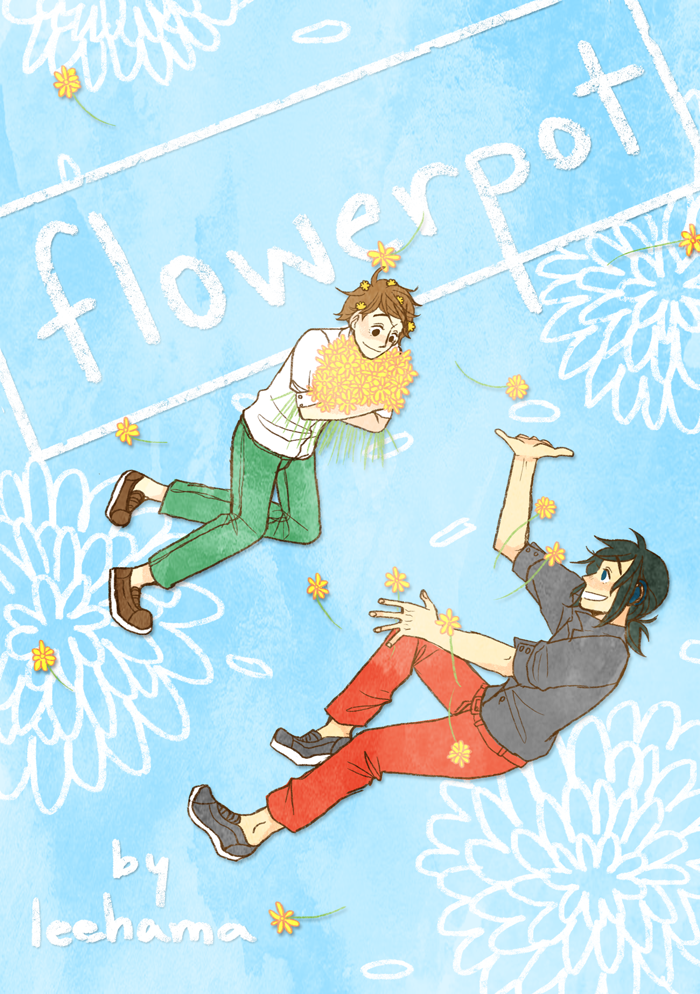
1. Flowerpot: "A story about a boy who grows dandelions from his head because of a mysterious disease, and all the problems that entails. Ten years ago, Ben was the first person to be infected by a strange disease that causes flowers to grow from his body every spring and summer.  In a world where flowers have become frightening, Ben has come to accept that most people will want to keep their distance from his dandelions.  However, when an enthusiastic photographer arrives out of the blue and asks Ben to be a part of his project, Ben begins to discover what being a “flowerpot” really means."

Ben is Patient Zero for fleurine, a recent illness that causes flowers to grow from his hair. Flowers are feared as carriers of the infectious disease, and "flowerpots" like Ben must guard against people's prejudices. A fluffy comic with lots of friendship and flowers, not to mention some succulents, annoying relatives, and cuddly friends.

Some swearing (Eileen can get angry).

Read here: http://flowerpot-comic.tumblr.com/post/136451157935/flowerpot-title-page-extra-fleurine-pamplet

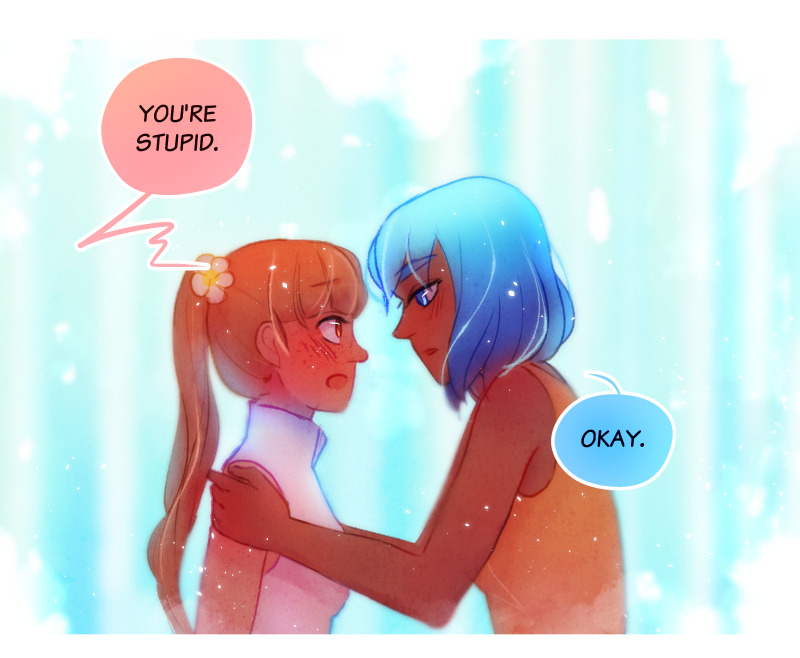
2. Always Human: "This is a story about nanobots, genetic engineering, and two girls falling in love. No matter how technology changes us, we'll always be human."

Sunati's always admired the one girl she always sees at the train station without any "mods," or genetic modifications like the ones she's always used to. Then she finds out the reason Austen isn't modding is because she can't; she has a syndrome that prevents her from living like everyone else does. Also super fluffy with friendship, representation to the nines, real-world problems (stress! failure! feeling like an impostor!). A watercolor art style that's super calming.

Some swearing in Spanish (from Austen).

Read here: http://www.webtoons.com/en/romance/always-human/1-i-guess-thats-why-i-admire-her/viewer?title_no=557&episode_no=1

3. Tea Dragon Society: "The Tea Dragon Society is about a young blacksmith apprentice, Greta, who is learning her craft but isn’t entirely sure what use it has in modern society. When she encounters a tea dragon and becomes closer to those who raise them and grow their tea, she learns about the dying art form and how it enriches the lives of those she meets—and eventually her own. With the experiences and the memories she makes, she begins to wonder if there’s a value in craft all of its own."

A soft lineless fantasy style: tea dragons are a notoriously finicky breed, treasured for their priceless tea. When Greta, a blacksmith's daughter who's more compassionate than plucky, rescues a jasmine green dragon, she learns about the wise elder Hesekiel and his old friend Erik who raise them. The fluffiest thing I've ever read—super calming, cute art, and worldbuilding to the nines!

Super family friendly, great for anyone at all who needs more cuddly dragons in their lives.

Read here: http://teadragonsociety.com/comic/chapter-1/

4. Mooncakes: "Long-lost childhood crushes Nova Huang and Tam Lang have reunited for the first time in ten years. They have a lot more to deal with this time than just being the only two Asian kids in school (who also happen to both have magical abilities). The comic focuses on their relationship as they struggle through bills, family, and weird horse demons in ways that only a witch and a werewolf can."

Super cool to find urban fantasy that's not grimdark and edgy! The worldbuilding in this one is great: the witchy bookstore that Nova's grandmothers own, Nova's own stellar fashion sense, the art style in general! It's a classic comics line style. Not to mention how diverse it is! As it's shaping up, it looks like this will be a fun fantasy adventure with a tinge of romance. Super diverse too: hard of hearing, LGBT+, and Asian American (!) characters galore!

A few swear words.

Read here: http://mooncakesomic.tumblr.com/

--

Yes, I read a lot of fluff. That's what comics are to me: they're short, so they're mostly for rereading value. I love the characters and the worlds, and I want everyone to have a happy ending! It's perfect for scrolling through on a bad day.

Happy reading!
~Citali

Friday, April 14, 2017

BILL BILL BILL BILL (No, Not That One)

Hey, guys! It's Willow here, and after 2 years, I'm jumping right back into Doctor Who.

As some of you might know, Doctor Who's 10th season starts this Saturday (April 15th).

Normally, I wouldn't make a whole entire post just to talk about a new season of a show, but this season? This season is special.

For one, it's the last season of both Peter Capaldi (the 12th Doctor) and showrunner Steven Moffat.
(I won't pretend I'm not glad to see Moffat go, but that's a story for another time.)

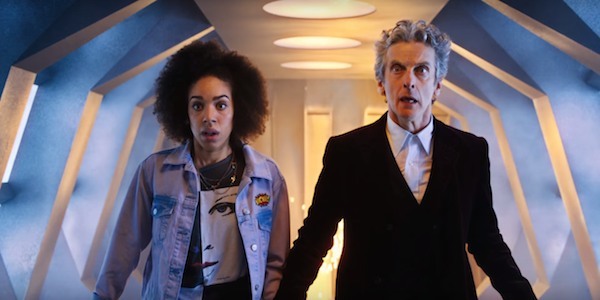
It's also the introduction of a new companion: BILL POTTS.

I barely know anything about Bill (played by Pearl Mackie), but I love her already.

Why? Well.


  • She's no one special. She's not Clara Oswald, the Impossible Girl, woven into the Doctor's timeline and his hearts. She's just an ordinary human being who's been given an extraordinary opportunity.
  • Doctor Who, here, is returning to its roots. At its core, it is a show about (ironic though it seems) humanity, about how normal people can do incredible things if you just give them the chance.
  • It hasn't exactly adhered to that standard recently, though. Ever since Moffat took over as showrunner (from the inimitable Russel T. Davies), the show has gotten ever more convoluted and its characters more ~special~. In my opinion, it's too much. I, for one, miss the simplicity, the humanity of RTD-era Who, and I know I'm not the only one who does. So of course I'm glad the show's going back to where it started.
  • Bill is New Who's second POC companion-- third, if you count Mickey Smith. I can't stress enough the importance of diversity in media, and Bill is an important step forward.
  • She's also openly gay, and the first companion to be so. Once again: diversity. To have one of the show's main characters be both POC and LGBT+ is an incredible milestone. (She's not the first LGBT+ character on the show*, but she's the first gay companion.) (*Jack Harkness, Madame Vastra, Jenny, River Song, Clara Oswald, etc.)
Judging from the trailer, it's going to be a somewhat more light-hearted season, one that's focused on misadventures throughout spacetime rather than destiny and ominous prophecies. I'm also excited to see the return of John Simm's the Master, and how he interacts with Capaldi's Doctor and Michelle Gomez's Missy. 

All in all, this season looks to be absolutely ~fabulous~ so far, and I can't wait to watch it!

Happy watching,
Willow

Thursday, April 6, 2017

Solarpunk

Hey guys! We're back from a bit of a hiatus. We're announcing a new schedule: we'll try to send out a new post to you all every Thursday (or at least once a week), even to just check in. Hope to see you all a bit more!

Can I talk about science fiction for a bit? Not the Victorian original science fiction mixed with fantasy that is steampunk. Not the robots and distant universes that is classic sci-fi. Not the artificial intelligences and spaceships that is space opera. Not the dictatorships and near futures that is dystopia. But the science fiction that is solar panels and art and rebellion in a beautiful way and in a gritty way that is solarpunk, also known as one of the leading subgenres of optimistic fiction and science fiction. 

I've written a little about solarpunk before. But what exactly is it?

It's a subgenre of sci-fi that's mostly still in ideological stages—unlike other genres who can clearly point to a founding author, the nature of solarpunk is that its inspiration comes from lots of varied authors: Nnedi Okorafor's afrofuturism, Ernest Callenbach's environmental utopia, Alaya Dawn Johnson's Brazilian monarchy, Neal Stephenson's optimistic principle-based sci-fi. A few founding anthologies such as Wings of Renewal and Hieroglyph have been produced, but not much more than that.

Personally, I see solarpunk as an optimistic, aesthetic sci-fi—not built on flat white male characters like Jules Verne's classics, not as dark or pessimistic as The Hunger Games or Divergent, and more technologically advanced and responsible than the classic '50s sci-fi of, say, Philip K. Dick's Do Androids Dream of Electric Sheep or the I, Robot works of Isaac Asimov. 

The idea is that it's a futuristic world that we can begin building now: embracing the valuable, diverse current cultures and the complexities of current issues and incorporating that kind of responsibility into mainstream society in a way that's still a reachable standard today. 

What I find most interesting about solarpunk's emergence is that its two founding documents, so to speak, are 1) a series of images of solarpunk fashion and architecture, created by an artist and 2) a political philosophy drafted by a member of Arizona State University's Center for Science and the Imagination. In other words, this genre is built on ideas by people from what others might call the opposite ends of the academic spectrum. 

Members of the solarpunk community now write anthologies; cosplay solarpunk fashion; make art; write fantasy and sci-fi taking place within a solarpunk world; ponder how society today would change in a more ideal solarpunk world; share experimental science that could have futuristic applications; and figure out how we can work today to make our world a little bit more optimistic and a little bit, dare I say, prettier. 

The political side of solarpunk: social justice for everyone. The world today isn't the ideal, and there are things that we can change to make it closer to one. How would whole systems change to ensure the rights of girls, the poor, the disadvantaged, the disenfranchised? How would income work in a world where robots could do the manual labor and where the sun and the wind and possibly some photosynthetic algae could give us endless energy? What about the educational system, charity work, democracy? How could the system be changed to "make scientists heroes again"?

It might seem like fluff or utopia, but solarpunk is the punk-rock response to today's world and today's fiction. In a world where the mainstream is discouraging radical diversity and love, acknowledging problems—and more importantly, their solutions—and living hopefully is the rebellion.

Solarpunk is something that I love because I can stretch it, and because there's more than just writing advice in the community. I want to read a story about a way to build a city without coal or carbon dioxide—then be directed to a link about how people are building it now. I want to read colorful stories about dragons with solar-panel wings and helicopters running on biofuel—in the same universe. I want to see characters who look like me and with backstories like my parents', written by an author who looks like me and my parents. I want to be part of a community where the #solarpunk tag has art and cosplay and photos and exposés and research and writing, whether it's fantasy or sci-fi or could take place in my neighbor's backyard right now without me having a clue. I love solarpunk because it's being built right now, and I'm having a tiny part in that.

Happy reading,
~Citali

Sunday, April 2, 2017

ICBD 2017

Salutations! Our apologies from having been away from the blog for a bit. I promise we haven't left this corner of the internet behind!

Happy April 2! It's fitting that the day after the good-natured (hopefully) fun of April Fool's Day is a day honoring the good-natured, hopeful, and good-clean-fun world of children's literature--International Children's Book Day!

The date, though, isn't related to April Fool's; it honors the birthday of Hans Christian Andersen, classic fairy-tale author.

Whether you're of board-book, picture-book, chapter-book, or middle-grade, or whether you've moved past the children's section to YA or beyond, I for one owe so much of my book-loving, fandom-crazy, "unironially enthusiastic" identity to the books I read and was read from that perfect children's sections. To those books, those authors, and their supporters--happy ICBD 17!

Happy reading!
~Citali

Friday, January 27, 2017

Star Wars Has a Women of Color Issue

Hey, everyone. Willow here! The title of this post is fairly self-explanatory, so. Yeah.

A month or so ago, Rogue One: A Star Wars Story was released. Citali and I went to watch it together, and came out trembling, emotional, in awe.

What makes Rogue One so great is that not only is it gorgeously written, it's also infinitely more diverse than any Star Wars movie has ever been.

Only one of the protagonists was white. The others-- each with a fleshed-out story arc and excellent characterization-- were all men of color. 

Excellent!

But.

The white character was Jyn Erso, only female lead and arguably the main character.

Look. Every time there has been a new Star Wars story, the main female character has been white.

Padmé Amidala. Leia Organa. Rey. And now, Jyn.

Star Wars has a WOC issue. Namely: there are none.

But Willow, you say. What about Steela Gerrera? Or Depa Billaba? Or Korr Sella? Or Breha Organa? Or--

Well, my dear reader, what do all those women have in common? Oh, that's right. They're all minor characters. And they're all dead.

Fine. But what about Sana Starros? Or that one Rebel from Rogue One?

Hmmm. Tell me, if you go up to a hundred random people, how many of them do you think would recognize the name "Sana Starros"?

The galaxy of Star Wars is bigger than just the movies, yes. There are animated TV shows and books and comics galore, but here's the thing. The movies are the most important part. They're the franchise's biggest, most popular branch. 

If you want diversity in Star Wars, you need it in the movies. And I'm not saying that Finn and Poe and Chirrut and Baze and Cassian and Bodhi aren't helping, but we need our WOC too.

So give me a Calrissian daughter, or Finn's mother, or Poe's cousin. Give me WOC Jedi and WOC Sith and WOC pilots and stormtroopers and civilians and bounty hunters. Give me queer WOC characters and trans WOC characters and old WOC and young WOC and--

Well. You get my point, no?

Willow

Friday, December 30, 2016

Six of Crows by Leigh Bardugo: Book Review

Happy 2017! I figured to start the new year with a massive current fave.

Want a terrifying fact? It's been more than a year since my (our) last book review post, which was for Dorothy Must Die back in October 2015. Now to fix that!

Six of Crows and its partner in crime (the second half of its duology), Crooked Kingdom, are masterpieces. To break it down to whatever might make you pick up a book: the plot, the worldbuilding (*swoon*), the quotability, the characters (*double swoon*), and the amazing fandom, all of them are amazing and cinammon roll-y.

The plot: A thrumming heist story full of twist after twist, reveal after reveal, triumph over triumph. It's almost impossible to put down; it starts with a bang and ends heart-wrenchingly but hopefully.

The worldbuilding: Taking place in a gritty low fantasy city resembling Amsterdam in the nineteenth century. Realism, well-built infrastructure both in and out of the narrative, and the intriguing system of the Grisha Small Science (what others might think of as magic).

The quotability: Here are just a few favorite bits:
  • “It's not natural for women to fight."
    "It's not natural for someone to be as stupid as he is tall, and yet there you stand.” 
  • Kaz leaned back. "What's the easiest way to steal a man's wallet?"
    "Knife to the throat?" asked Inej.
    "Gun to the back?" said Jesper.
    "Poison in his cup?" suggested Nina.
    "You're all horrible," said Matthias.
  • "Why does it matter?”
    “I don’t know!” Jesper said angrily. “Maybe I liked your stupid face."
There's just so much quality banter and everyone loves/hates each other and they're just all amazing.

The characters: Personally, they're my favorite part. I present the following:
  • A former acrobat, stolen as a slave, sold as an "indentured servant," now the best spy in the city and ready to fight for her life and her friends
  • A young man who's immensely secretive about his past, who's risen to his title of "Dirtyhands" among the grittiest gangs of Ketterdam by ruthless crime and grudging respect
  • A girl who can turn people's bodies against them, a trained soldier in Ravka's army, far from her home
  • A still-loyal soldier of Fjerda, Ravkans' enemy, imprisoned miles from his nation and battling allegiances
  • A sharpshooter with a gambling problem and a longing for trust
  • An innocent demolitions expert who is ACTUALLY A CINNAMON ROLL (Calm down, Citali)
The fandom: As fandoms go, the SoC/CK fandom is still pretty small and amazing. Also we have... like... amazing fanartists? Like the actual angel who drew this Inej and Wylan sketch:


The genre: It seems to bridge genres: young adult fantasy, with a tinge of LGBT+ fiction, as well as a heist narrative, combined with an action plot full of twist after twist. Each of the main character simultaneously makes the reader adore them and hate them. Each plot twist elevates the plot and keeps the reader completely engaged--the book is virtually “unputdownable.” It’s also followed by an, if possible, even better sequel (Crooked Kingdom) and preceded by a trilogy, letting readers who are hooked dive even further into the author’s worldbuilding.

This series is just So! Good! Agh!

Happy reading!
~Citali