Thursday, May 11, 2017

Housekeeping

Hello, lovely readers!

Happy Thursday! As finals approach, we're taking a quick break from our ~regularly scheduled~ well-planned-out post programming to just give a bit of an update on what's going on at the Archives.

  • Willow and I did NaNo together this past April Camp NaNo. For the first time, Willow captained our cabin, and for the first time, we both won Camp with our word goals of 10k. (I'm not saying those were related, but those were definitely related). 
  • I also did a more loose Camp than I'm used to. Usually, it's a lot easier for me to write during Camp in April and July than it is in November, so I attempt my best writing in April. However, I realized that the story I was writing... wasn't really going a direction that was something I wanted to pursue for more plot events or for revisions. I did get to write 5k on a story that I really love, and that I want to keep writing, though!
  • Don't worry, I'm still working on the Reading Without Walls challenge. There will be booklists!
  • Free Comic Book Day was celebrated the first Saturday this May! I picked up some indie comics and also a v. cool graphic novel (which will feature in Reading Without Walls #2) for 20% off at my friendly neighborhood indie comic bookstore (which is, in fact, a real thing).
  • One of the cornerstones of solarpunk lit for YA is The Summer Prince by Alaya Dawn Johnson, set in futuristic Brazil. I recently started reading it, and am awed by the worldbuilding. 
  • Some posts to come: Reading Without Walls, Camp NaNo reflections, an analysis of grammar in fiction inspired by St.Owl's blog, some thoughts on short stories/novelettes, and some vague ideas-that-aren't-posts-yet about libraries and communities (of course).
With luck, we'll have a proper bookish post next week.
Until then, happy reading!
~Citali

Thursday, May 4, 2017

Literary Tourism


Not to beat the dead horse into the ground, but, as you know, I went to England over the summer. When asked why I chose to go to London (because the trip location was my choice), I usually named one of or all of the following reasons:
  1. Foreign editions of books that also were readable (because I read only English).
  2. No language barrier (although I had rather underconsidered the barrier of accents).
  3. Harry Potter
One of which is literary tourism in and of itself. But as we were in England, I found that, voluntarily or involuntarily, I was being a literary tourist beyond buying foreign editions (actually only one foreign edition, which I will come back to later) and visiting the aforementioned dead horse, the Harry Potter studios, which I will stop talking about now.

We went to Stonehenge and the white chalk horses near Bath and visited the British Museum in London. However, I also visited an amazing and amazingly large bookstore in Canterbury, the site of Chauncer's Canterbury Tales (which features pilgrims telling tales to each other on their way to the Canterbury Cathedral).

And amazing sites aside (because they were amazing) I couldn't stop thinking that, canonically, Richard Campbell Gansey III (of The Raven Cycle fame) walked the circle around Stonehenge and saw the white horses and was probably making nerdy notes in a notebook about ley lines the entire time. I picked up a book about ley lines. In a non-Ganseylike way, I felt it was a Ganseylike thing to do (which you'll understand if you've read The Raven King; there's a passage about Gansey thinking that what most people think of as Ganseylike doesn't really get at his essence, just his outside. Ley lines are part of his outside).

Nota bene: I bought a British copy of The Raven Boys, since I don't own a copy and I felt that I'd been thinking about the books an unusual amount (I didn't get any HP editions because I love Mary GrandPré's covers and chapter illustrations, which aren't in the British editions). Reading it, I rediscovered how aggressively car-related it is. Why, you might ask? Because "tyre," "kerb," and "petrol," all aggressively car-related words and aggressively British words, are very prevalent. It's weird to hear characters with American Southern accents "say" "petrol," to my American brain, anyway.

I kept thinking about how Hermione-like I was being as I enthused about YA foreign editions in a Waterstone's. I thought about the Hogwarts Express as we took the train from London.

Literary tourism is about seeing where authors wrote, where filmmakers recreated, and where characters walked, both in-text and out. I'm all for walking the same ground as famous people, but to walk the same ground as fictional people is pretty cool too.

Happy reading!
~Citali

P.S. Here's a John Green.
https://www.youtube.com/watch?v=xHfYj48mDCY

Thursday, April 27, 2017

Reading Without Walls

Have you heard of Gene Luen Yang? You might have read Boxers, Saints, or American Born Chinese, all graphic novel titles that have won tons of awards! They're different takes on what happened and is still happening when Western culture meets, in this case, Chinese heritage. Whether it's about the conflict between religions or just another student struggling to fit in at school, his writing is a valued perspective in a fun format.

Information and learning are power. By loving books or at least being open to them, we bibliophiles take in so much information, even when we're just reading for fun. Why not take that opportunity to read books that will teach you something while still giving you that high point that comes when you want to know what happens next and you're in love with all the characters and you've been caught up in a world and a conflict that's not your won?

Gene Luen Yang is the National Ambassador for Young People's literature, and he's challenged us bookworms (especially the ones who read middle grade and YA lit) to the Reading Without Walls challenge. To celebrate the sheer awesomeness of this challenge, I made mini book lists for each of the three suggestions that are part the challenge.

1. Read a book about someone who doesn't look like you or doesn't live like you. (Race, sexuality, creed, gender, location, class, physical and mental ability, on and on! There are so many ways to experience the world.)
2. Read a book about a topic you don't know about. (Even if you call yourself a humanities person, you'll need to learn about the world to write your novels (or poems, or interpretative dances). Read about science: how to raise bees, the mythology of the planets, optical illusions. Read about history: great queens, the quirky people who were just like us. Not a nonfiction person? Read a book where the main character works stage crew, or does ballet.  What we don't know is huge.)
3. Read a format you don't usually read. (Read some poetry, if you're a prose person. Read a graphic novel, even if you think they're too easy. Listen to an audiobook, if you usually skim the words or if you can't imagine what an accent sounds like.)

Booklist to come! Happy reading (or listening),
~Citali

Thursday, April 20, 2017

Dandelions and Dragons: Webcomic Fluff Dump

I've (Citali) been reading more webcomics lately! Here's my list + spiels.

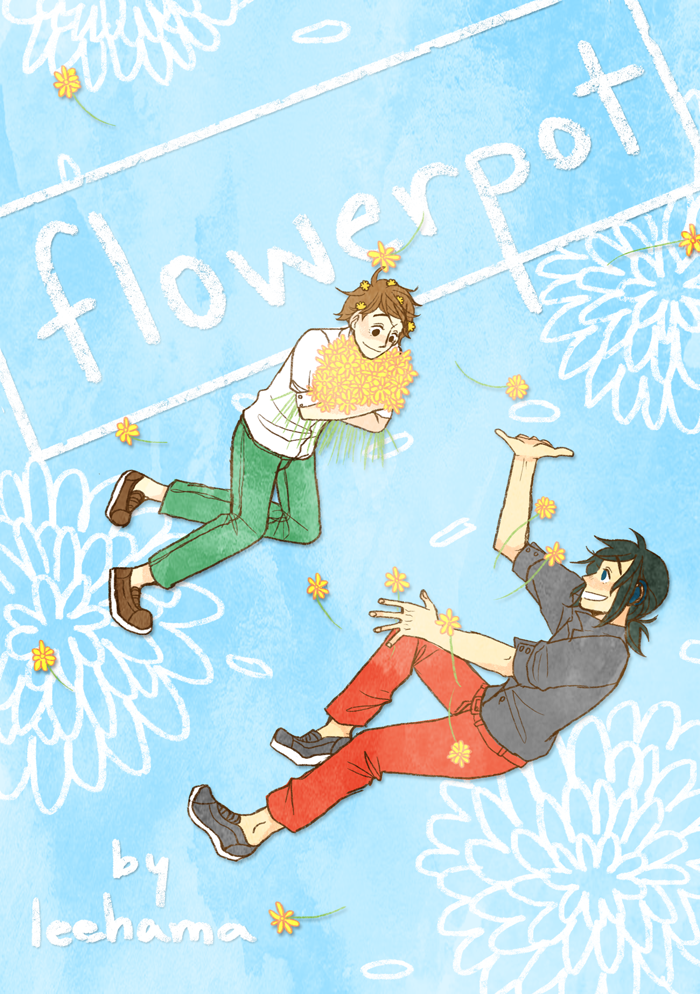
1. Flowerpot: "A story about a boy who grows dandelions from his head because of a mysterious disease, and all the problems that entails. Ten years ago, Ben was the first person to be infected by a strange disease that causes flowers to grow from his body every spring and summer.  In a world where flowers have become frightening, Ben has come to accept that most people will want to keep their distance from his dandelions.  However, when an enthusiastic photographer arrives out of the blue and asks Ben to be a part of his project, Ben begins to discover what being a “flowerpot” really means."

Ben is Patient Zero for fleurine, a recent illness that causes flowers to grow from his hair. Flowers are feared as carriers of the infectious disease, and "flowerpots" like Ben must guard against people's prejudices. A fluffy comic with lots of friendship and flowers, not to mention some succulents, annoying relatives, and cuddly friends.

Some swearing (Eileen can get angry).

Read here: http://flowerpot-comic.tumblr.com/post/136451157935/flowerpot-title-page-extra-fleurine-pamplet

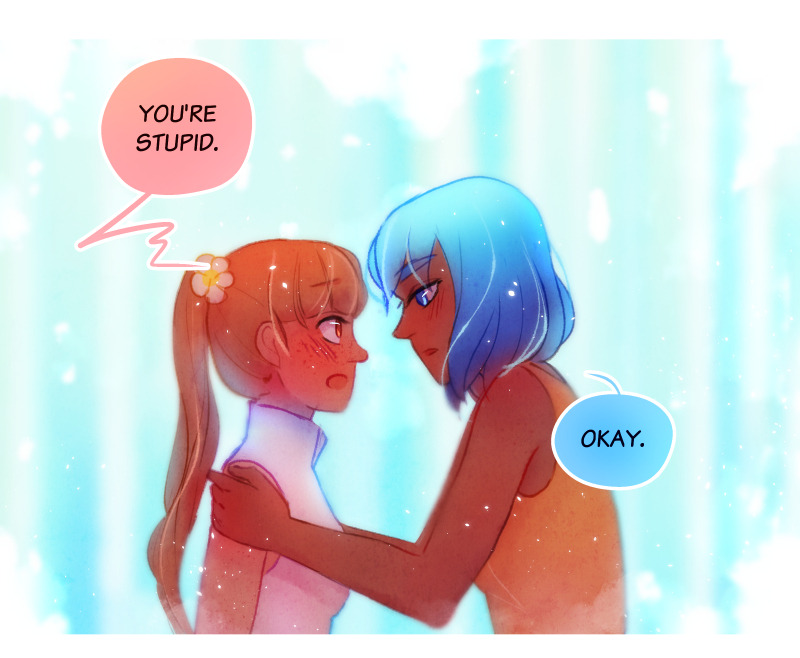
2. Always Human: "This is a story about nanobots, genetic engineering, and two girls falling in love. No matter how technology changes us, we'll always be human."

Sunati's always admired the one girl she always sees at the train station without any "mods," or genetic modifications like the ones she's always used to. Then she finds out the reason Austen isn't modding is because she can't; she has a syndrome that prevents her from living like everyone else does. Also super fluffy with friendship, representation to the nines, real-world problems (stress! failure! feeling like an impostor!). A watercolor art style that's super calming.

Some swearing in Spanish (from Austen).

Read here: http://www.webtoons.com/en/romance/always-human/1-i-guess-thats-why-i-admire-her/viewer?title_no=557&episode_no=1

3. Tea Dragon Society: "The Tea Dragon Society is about a young blacksmith apprentice, Greta, who is learning her craft but isn’t entirely sure what use it has in modern society. When she encounters a tea dragon and becomes closer to those who raise them and grow their tea, she learns about the dying art form and how it enriches the lives of those she meets—and eventually her own. With the experiences and the memories she makes, she begins to wonder if there’s a value in craft all of its own."

A soft lineless fantasy style: tea dragons are a notoriously finicky breed, treasured for their priceless tea. When Greta, a blacksmith's daughter who's more compassionate than plucky, rescues a jasmine green dragon, she learns about the wise elder Hesekiel and his old friend Erik who raise them. The fluffiest thing I've ever read—super calming, cute art, and worldbuilding to the nines!

Super family friendly, great for anyone at all who needs more cuddly dragons in their lives.

Read here: http://teadragonsociety.com/comic/chapter-1/

4. Mooncakes: "Long-lost childhood crushes Nova Huang and Tam Lang have reunited for the first time in ten years. They have a lot more to deal with this time than just being the only two Asian kids in school (who also happen to both have magical abilities). The comic focuses on their relationship as they struggle through bills, family, and weird horse demons in ways that only a witch and a werewolf can."

Super cool to find urban fantasy that's not grimdark and edgy! The worldbuilding in this one is great: the witchy bookstore that Nova's grandmothers own, Nova's own stellar fashion sense, the art style in general! It's a classic comics line style. Not to mention how diverse it is! As it's shaping up, it looks like this will be a fun fantasy adventure with a tinge of romance. Super diverse too: hard of hearing, LGBT+, and Asian American (!) characters galore!

A few swear words.

Read here: http://mooncakesomic.tumblr.com/

--

Yes, I read a lot of fluff. That's what comics are to me: they're short, so they're mostly for rereading value. I love the characters and the worlds, and I want everyone to have a happy ending! It's perfect for scrolling through on a bad day.

Happy reading!
~Citali

Friday, April 14, 2017

BILL BILL BILL BILL (No, Not That One)

Hey, guys! It's Willow here, and after 2 years, I'm jumping right back into Doctor Who.

As some of you might know, Doctor Who's 10th season starts this Saturday (April 15th).

Normally, I wouldn't make a whole entire post just to talk about a new season of a show, but this season? This season is special.

For one, it's the last season of both Peter Capaldi (the 12th Doctor) and showrunner Steven Moffat.
(I won't pretend I'm not glad to see Moffat go, but that's a story for another time.)

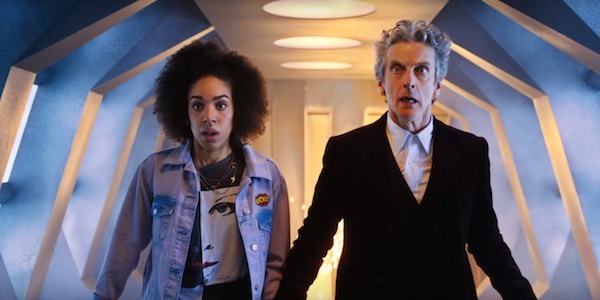
It's also the introduction of a new companion: BILL POTTS.

I barely know anything about Bill (played by Pearl Mackie), but I love her already.

Why? Well.


  • She's no one special. She's not Clara Oswald, the Impossible Girl, woven into the Doctor's timeline and his hearts. She's just an ordinary human being who's been given an extraordinary opportunity.
  • Doctor Who, here, is returning to its roots. At its core, it is a show about (ironic though it seems) humanity, about how normal people can do incredible things if you just give them the chance.
  • It hasn't exactly adhered to that standard recently, though. Ever since Moffat took over as showrunner (from the inimitable Russel T. Davies), the show has gotten ever more convoluted and its characters more ~special~. In my opinion, it's too much. I, for one, miss the simplicity, the humanity of RTD-era Who, and I know I'm not the only one who does. So of course I'm glad the show's going back to where it started.
  • Bill is New Who's second POC companion-- third, if you count Mickey Smith. I can't stress enough the importance of diversity in media, and Bill is an important step forward.
  • She's also openly gay, and the first companion to be so. Once again: diversity. To have one of the show's main characters be both POC and LGBT+ is an incredible milestone. (She's not the first LGBT+ character on the show*, but she's the first gay companion.) (*Jack Harkness, Madame Vastra, Jenny, River Song, Clara Oswald, etc.)
Judging from the trailer, it's going to be a somewhat more light-hearted season, one that's focused on misadventures throughout spacetime rather than destiny and ominous prophecies. I'm also excited to see the return of John Simm's the Master, and how he interacts with Capaldi's Doctor and Michelle Gomez's Missy. 

All in all, this season looks to be absolutely ~fabulous~ so far, and I can't wait to watch it!

Happy watching,
Willow

Thursday, April 6, 2017

Solarpunk

Hey guys! We're back from a bit of a hiatus. We're announcing a new schedule: we'll try to send out a new post to you all every Thursday (or at least once a week), even to just check in. Hope to see you all a bit more!

Can I talk about science fiction for a bit? Not the Victorian original science fiction mixed with fantasy that is steampunk. Not the robots and distant universes that is classic sci-fi. Not the artificial intelligences and spaceships that is space opera. Not the dictatorships and near futures that is dystopia. But the science fiction that is solar panels and art and rebellion in a beautiful way and in a gritty way that is solarpunk, also known as one of the leading subgenres of optimistic fiction and science fiction. 

I've written a little about solarpunk before. But what exactly is it?

It's a subgenre of sci-fi that's mostly still in ideological stages—unlike other genres who can clearly point to a founding author, the nature of solarpunk is that its inspiration comes from lots of varied authors: Nnedi Okorafor's afrofuturism, Ernest Callenbach's environmental utopia, Alaya Dawn Johnson's Brazilian monarchy, Neal Stephenson's optimistic principle-based sci-fi. A few founding anthologies such as Wings of Renewal and Hieroglyph have been produced, but not much more than that.

Personally, I see solarpunk as an optimistic, aesthetic sci-fi—not built on flat white male characters like Jules Verne's classics, not as dark or pessimistic as The Hunger Games or Divergent, and more technologically advanced and responsible than the classic '50s sci-fi of, say, Philip K. Dick's Do Androids Dream of Electric Sheep or the I, Robot works of Isaac Asimov. 

The idea is that it's a futuristic world that we can begin building now: embracing the valuable, diverse current cultures and the complexities of current issues and incorporating that kind of responsibility into mainstream society in a way that's still a reachable standard today. 

What I find most interesting about solarpunk's emergence is that its two founding documents, so to speak, are 1) a series of images of solarpunk fashion and architecture, created by an artist and 2) a political philosophy drafted by a member of Arizona State University's Center for Science and the Imagination. In other words, this genre is built on ideas by people from what others might call the opposite ends of the academic spectrum. 

Members of the solarpunk community now write anthologies; cosplay solarpunk fashion; make art; write fantasy and sci-fi taking place within a solarpunk world; ponder how society today would change in a more ideal solarpunk world; share experimental science that could have futuristic applications; and figure out how we can work today to make our world a little bit more optimistic and a little bit, dare I say, prettier. 

The political side of solarpunk: social justice for everyone. The world today isn't the ideal, and there are things that we can change to make it closer to one. How would whole systems change to ensure the rights of girls, the poor, the disadvantaged, the disenfranchised? How would income work in a world where robots could do the manual labor and where the sun and the wind and possibly some photosynthetic algae could give us endless energy? What about the educational system, charity work, democracy? How could the system be changed to "make scientists heroes again"?

It might seem like fluff or utopia, but solarpunk is the punk-rock response to today's world and today's fiction. In a world where the mainstream is discouraging radical diversity and love, acknowledging problems—and more importantly, their solutions—and living hopefully is the rebellion.

Solarpunk is something that I love because I can stretch it, and because there's more than just writing advice in the community. I want to read a story about a way to build a city without coal or carbon dioxide—then be directed to a link about how people are building it now. I want to read colorful stories about dragons with solar-panel wings and helicopters running on biofuel—in the same universe. I want to see characters who look like me and with backstories like my parents', written by an author who looks like me and my parents. I want to be part of a community where the #solarpunk tag has art and cosplay and photos and exposés and research and writing, whether it's fantasy or sci-fi or could take place in my neighbor's backyard right now without me having a clue. I love solarpunk because it's being built right now, and I'm having a tiny part in that.

Happy reading,
~Citali

Sunday, April 2, 2017

ICBD 2017

Salutations! Our apologies from having been away from the blog for a bit. I promise we haven't left this corner of the internet behind!

Happy April 2! It's fitting that the day after the good-natured (hopefully) fun of April Fool's Day is a day honoring the good-natured, hopeful, and good-clean-fun world of children's literature--International Children's Book Day!

The date, though, isn't related to April Fool's; it honors the birthday of Hans Christian Andersen, classic fairy-tale author.

Whether you're of board-book, picture-book, chapter-book, or middle-grade, or whether you've moved past the children's section to YA or beyond, I for one owe so much of my book-loving, fandom-crazy, "unironially enthusiastic" identity to the books I read and was read from that perfect children's sections. To those books, those authors, and their supporters--happy ICBD 17!

Happy reading!
~Citali